
Understanding Lime-Based Finishes: Natural Materials for Timeless Interiors
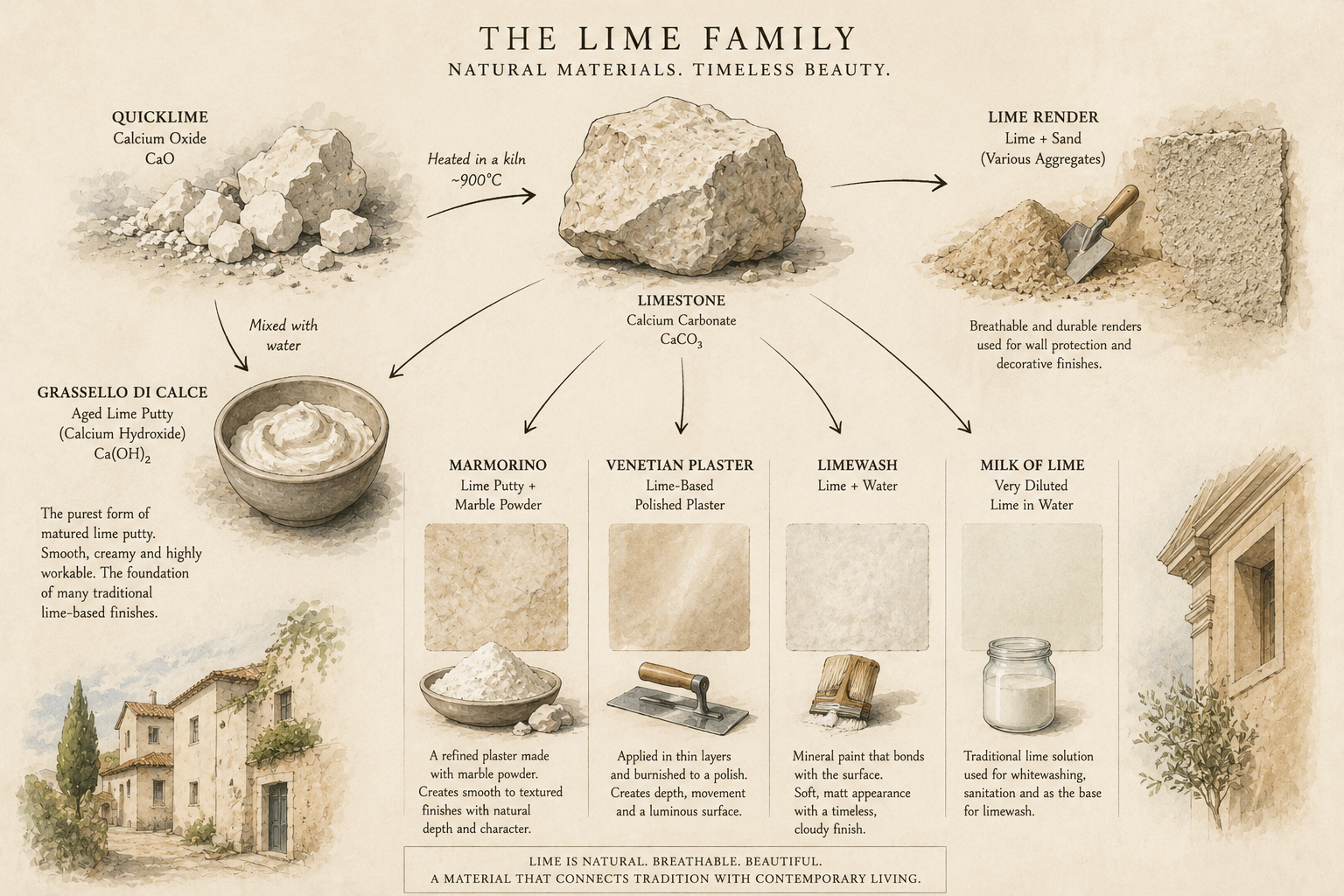
Following our introduction to the history and science of lime, it is worth exploring how this remarkable material continues to be used today.
Modern decorative finishes often focus on synthetic coatings and acrylic products, yet many of the world's most beautiful surfaces are still created using traditional lime-based materials.
From polished Venetian plasters to rustic limewashed walls, lime remains one of the most versatile and elegant finishing materials available.
Lime Versus Acrylic Products
One of the most common misconceptions is that all decorative coatings perform in the same way. In reality, lime and acrylic products behave very differently.
Lime-Based Finishes
Lime finishes are mineral-based materials derived from natural limestone. They cure through carbonation, gradually absorbing carbon dioxide from the atmosphere and returning to a stone-like state.
Benefits include:
Natural appearance and depth
Excellent vapour permeability
Low environmental impact
Unique interaction with light
Traditional and authentic character
Acrylic Finishes
Acrylic products rely on synthetic resins to form a protective film over the surface.
Benefits include:
Greater water resistance
Consistent colour and texture
Faster application
Easier maintenance
Wide range of colours
While acrylic finishes excel in many modern applications, they generally cannot reproduce the subtle movement, depth and natural beauty associated with traditional lime products.
Neither system is inherently better; each serves a different purpose depending on the project.
Understanding Common Lime-Based Products
The world of lime finishes can seem confusing at first. Many products share the same origins yet produce very different results.
Grassello (Lime Putty)
Grassello is the purest form of matured lime putty.
Produced by slaking quicklime and allowing it to mature, grassello forms the foundation of many traditional Venetian plaster systems.
It is smooth, creamy and highly workable, making it ideal for polished decorative finishes.
Marmorino
Marmorino combines lime putty with carefully graded marble powders.
The addition of marble aggregate creates a finish that can range from soft matte textures to highly polished surfaces.
Historically used throughout Venice and Northern Italy, marmorino remains one of the most popular decorative lime finishes in contemporary design.
Venetian Plaster
Although often used as a generic term, Venetian plaster generally refers to polished lime-based decorative finishes applied in multiple thin layers.
These finishes can create remarkable depth, movement and visual richness, particularly when burnished to a polished surface.
Limewash
Limewash is a traditional mineral paint made from lime and water.
Unlike modern paints that form a film, limewash penetrates and bonds with mineral substrates, producing a soft, cloudy appearance that changes subtly with lighting conditions.
Its distinctive character has made it increasingly popular in both traditional and contemporary interiors.
Milk of Lime (Latte di Calce)
Milk of lime is an extremely diluted suspension of lime in water.
Historically it was used for sanitation, whitewashing and agricultural purposes, but it also forms the basis of many traditional limewash systems.
Its simplicity reflects one of lime's greatest strengths: extraordinary performance from remarkably simple ingredients.
Lime Render
Lime render combines lime binders with sand aggregates to create protective and decorative wall coatings.
Used extensively throughout Mediterranean architecture, lime renders provide breathability while protecting masonry from the elements.
Depending on the aggregate size and application technique, lime renders can appear rustic, refined or highly decorative.
Why Designers Are Rediscovering Lime
In recent years, architects and designers have increasingly embraced lime-based finishes.
Part of this resurgence stems from a desire for authenticity. In a world filled with synthetic materials, lime offers something genuine: surfaces that age gracefully, interact with light naturally and develop character over time.
No two lime walls are ever completely identical.
This individuality is precisely what makes them so appealing.
The Artisan's Touch Perspective
At The Artisan's Touch, we believe that understanding a material is just as important as applying it.
Whether it is a traditional limewash, a polished Venetian plaster or a handcrafted marmorino finish, every lime-based surface carries with it centuries of craftsmanship and architectural heritage.
These finishes are more than decoration—they are part of a building tradition that has endured for thousands of years and continues to inspire modern interiors today.
