
Lime: The Material That Built Civilisations
Lime introduction
Long before modern paints, acrylic renders and cement-based coatings existed, there was lime.
For thousands of years, lime has been one of the most important building materials in human history, shaping some of the world's most enduring architecture. From ancient Roman villas to Venetian palaces, from Mediterranean farmhouses to historic churches, lime has played a central role in the way people built, protected and decorated their homes.
Where Lime Comes From
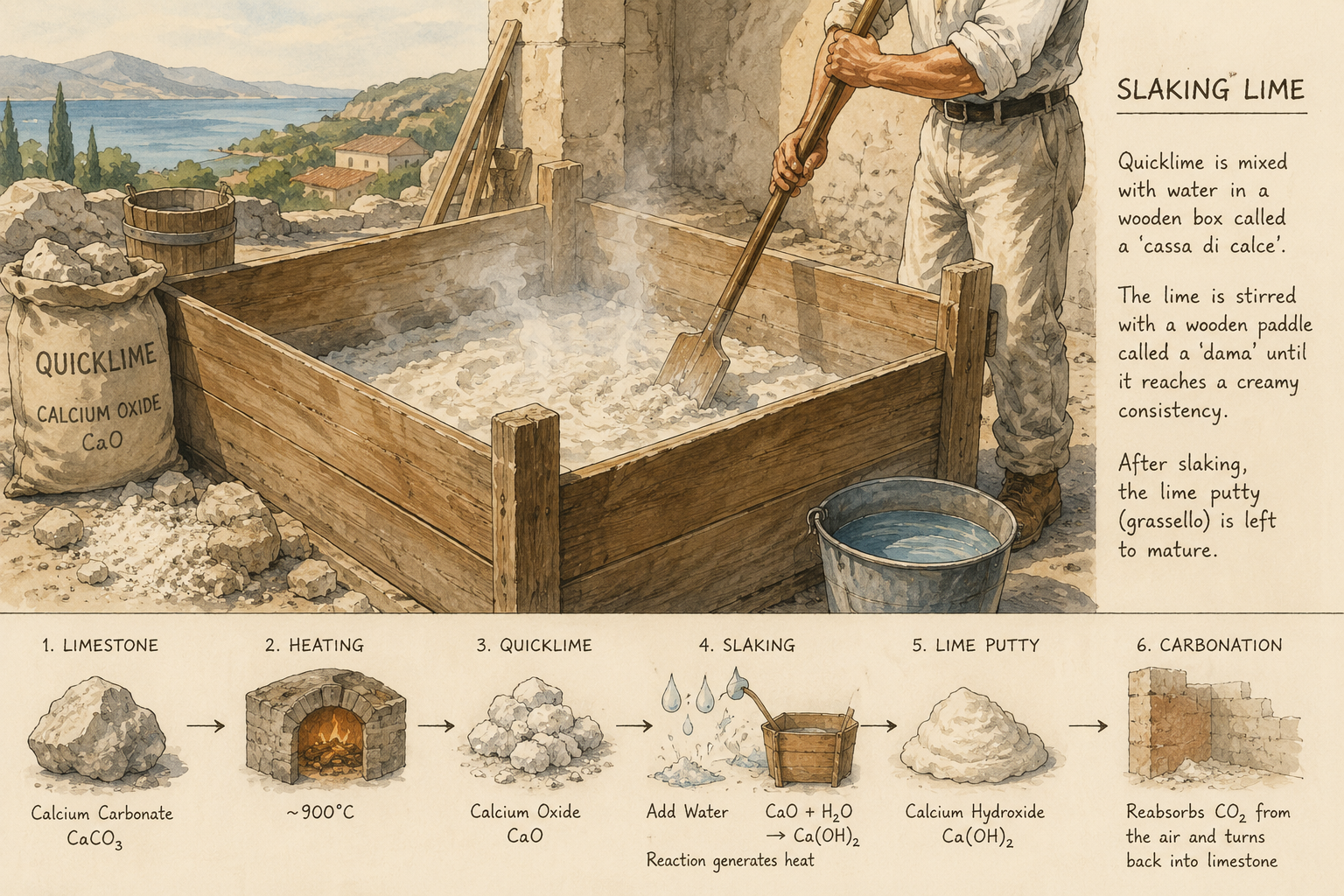
The journey begins with limestone, a natural sedimentary rock composed primarily of calcium carbonate.
When limestone is heated in a kiln at temperatures approaching 900°C, it undergoes a chemical transformation. Carbon dioxide is released, leaving behind calcium oxide, commonly known as quicklime.
This highly reactive material has been used for centuries as the starting point for countless traditional building products.
From Quicklime to Lime Putty
When water is added to quicklime, an energetic reaction occurs. Heat is generated and the material gradually transforms into calcium hydroxide.
This process, known as slaking, produces what artisans traditionally call lime putty or grassello.
Historically, master craftsmen would allow lime putty to mature for months, and sometimes even years, before using it. This ageing process improved its workability and contributed to the exceptional finishes seen in many historic buildings throughout Europe.
The Remarkable Cycle of Lime
One of the most fascinating aspects of lime is that its life cycle eventually returns it to its original state.
After application, lime slowly absorbs carbon dioxide from the atmosphere. Over time, the calcium hydroxide converts back into calcium carbonate, effectively becoming limestone once again.
This natural process, known as carbonation, explains why many lime-based finishes can remain stable for decades or even centuries.
In a sense, lime completes a full circle:
Limestone → Quicklime → Lime Putty → Limestone
It is one of nature's most elegant examples of a truly cyclical building material.
Why Lime Has Endured for Centuries
Unlike many modern materials, lime possesses characteristics that have allowed it to remain relevant across generations.
Breathability
Lime allows moisture vapour to pass through walls, helping buildings regulate humidity naturally. This is one reason why traditional Mediterranean buildings often feel cool and comfortable even during hot summers.
Flexibility
Compared with modern cement products, lime is more accommodating to small movements within a structure. This flexibility helps reduce cracking and contributes to the longevity of historic masonry.
Natural Beauty
Few materials interact with light quite like lime. Its subtle variations, depth and soft reflective qualities create surfaces that feel alive rather than manufactured.
Sustainability
Because lime reabsorbs a portion of the carbon dioxide released during firing, it remains an important material in discussions about sustainable and traditional construction methods.
Lime and the Mediterranean Tradition
Across Italy, Greece, Spain and many other Mediterranean regions, lime became more than a building material—it became part of the cultural identity of architecture itself.
Whitewashed villages, polished Venetian plaster walls, traditional lime renders and decorative stuccoes all owe their existence to the versatility of lime.
Many of these finishes continue to inspire contemporary designers today, proving that true craftsmanship never goes out of style.
A Material Worth Rediscovering
In an era dominated by synthetic products and fast construction methods, lime reminds us that some of the best building materials are also the oldest.
Its history, performance and beauty have stood the test of time for thousands of years.
At The Artisan's Touch, we appreciate lime not only for the finishes it creates, but for the remarkable tradition of craftsmanship it represents—a tradition that continues to inspire modern decorative and architectural surfaces today.
